MICHAEL A. PATYEN, RICHARD A. ERICKSON
This article reports the results of the recent review of 232 records of 91 species by the California Bird Records Committee (hereafter the Committee or CBRC). Of these records, 171 were accepted, representing an acceptance rate of 73.7%.
This report contains records from 1943 through 1990, although the vast majority are from 1989 through spring of 1990. As in the CBRC's 13th report (Pyle and McCaskie 1992), San Francisco County was the best-represented, with 23 accepted records, 20 of which were from Southeast Farallon Island.
1-34
ROBERT D. DORN, JANE L. DORN
Fitton’s (1993) report on the distribution of the Western Screech-Owl (Otus kennicottii) and Eastern Screech-Owl (O. asio) in Wyoming was prompted by the lack of information on these species and their recent recognition as distinct. For nearly the same reasons, we undertook a similar project—without being aware of Fitton’s study.
35-42
DANIEL M. TAYLOR
In Idaho, the American Pipit (Anthus rubescens) has been considered primarily a migrant, either locally common but erratic (Larrison et al. 1967) or uncommon in spring and common in fall (Burleigh 1972). Several other writers (Merriam 1891, Merrill 1898, Newhouse 1960, Levy 1962) considered it an abundant fall migrant but gave no indication of actual numbers.
43-49
ERIC MELLINK, AMADEO M. REA
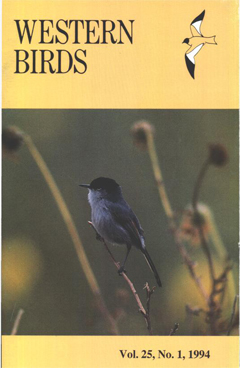
The California Gnatcatcher (Polioptila californica) was first described as a new species by Brewster (1881) from specimens collected at Riverside, California. Later, Grinnell (1926) merged it with Polioptila melanura, as a subspecies.
Phillips (1980) and Rea (1983) considered it a different species, and Atwood (1988), in a taxonomic revision of the black-tailed gnatcatcher complex, demonstrated that the two forms are sympatric in Baja California on the east side of the central peninsula (29°–31° N), have distinctly different vocalizations, and mate non-randomly.
50-62
JOHN E. HUNTER
Cowbirds sometimes appear to solicit preening both intra- and interspecifically; this head-down preening-invitation display has been well described by Chapman (1928), Selander and La Rue (1961), Selander (1964), Rothstein (1980), and Post and Wiley (1992). A Brown-headed Cowbird (Molothrus ater), for example, will approach another bird, point its bill downward, and freeze, presenting the crown and nape area.
63-65
RICHARD A. ERICKSON, ALAN D. BARRON, THOMAS E. WURSTER
On the evening of 5 July 1993, we discovered a Northern Saw-whet Owl (Aegolius acadicus) at approximately 2300 meters elevation in the Sierra San Pedro Mártir, Baja California (Norte). We found the bird near kilometer marker 86while owling along the main road through Parque Nacional Sierra de San Pedro Mártir, about 2 km east of La Corona de Arriba. At this point, the main road from the west descends steeply into a canyon separating La Corona de Arriba from the higher meadows at Vallecitos to the east.
66-68
Tim Manolis
The popularity of national and regional breeding bird atlases has grown steadily since the 1960s, and a number of California county atlas projects have been launched since the first one, started by Bob Stewart of Point Reyes Bird Observatory for Marin County in 1976 (see Manoil's Western Birds 22:92–94, 1991, for a history of atlas efforts in the state).
69-72