MATTHEW T. HEINDEL, KIMBALL L. GARRETT
In this report, we review 239 records of 86 species and one hybrid recently assessed by the California Bird Records Committee (hereafter the Committee or CBRC). Of these records, 160 were accepted, yielding an acceptance rate (68%) consistent with the most recent reports (Roberson 1993, Patten and Erickson 1994).
1-33
CARROLL D. LITTLEFIELD
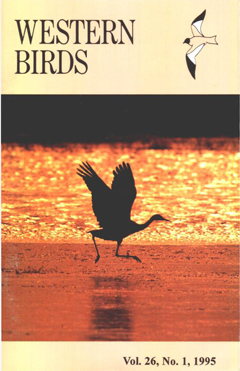
The population of the Greater Sandhill Crane (Grus canadensis tabida) wintering in the Central Valley was listed as a sensitive species by the U.S. Fish and Wildlife Service in 1982, and as a threatened species by the State of Californiain 1983. Many of these cranes breed in northeastern California. In 1988, I surveyed the species’ California breeding range, locating nests and following up on the fate of selected pairs.
34-38
RICHARD A. ERICKSON
We discovered two Marbled Murrelets (Brachyramphus marmoratus marmoratus) and an Ancient Murrelet(Synthliboramphus antiquus) at Ensenada, Baja California, in the early afternoon of 9 January 1994. We first saw the Marbled Murrelets from the beach just south of the southern jetty forming Ensenada Harbor.
39-45
DAVID J. DELEHANTY
The Mountain Quail (Oreortyx pictus) is among the most poorly known birds of the American West. No comprehensive study of the species’ breeding biology exists (Gutiérrez 1975, 1980). This is unfortunate because Mountain Quail populations have declined significantly in Washington (Wash. Dept. of Wildlife 1993), Oregon (K. Durbin, Ore. Dept. of Fish and Wildlife, pers. comm.), Idaho (T. Hemker, Ida. Dept. of Fish and Game, pers. comm.), and Nevada (S. Stiver, Nev. Div. of Wildlife, pers. comm.).
46-48
TROY CORMAN, GALE MONSON
In the United States, the Streak-backed Oriole (Icterus pustulatus) has been reported primarily as a casual fall and winter visitor to southern Arizona and southern California. Its main range extends from the western lowlands of Mexico south to Costa Rica in Central America (American Ornithologists’ Union 1983). In the Mexican state of Sonora, it nests in tropical thorn scrub and deciduous forests (especially riparian), north to about latitude 30° N. The northernmost known nest was found about 175 km south of the international boundary at Félix Gómez (S. Russell and Monson, unpubl. manuscript).
49-53
MICHAEL A. PATTEN, PHILIP UNITT, RICHARD A. ERICKSON, KURT F. CAMPBELL
December 1994 marked the fiftieth anniversary of a monumental event in California ornithology: the publication of The Distribution of the Birds of California by Joseph Grinnell and Alden H. Miller—perhaps the most thorough state avifauna ever produced.
54-64