KIMBALL L. GARRETT
Data on the identity, population sizes, trends, geographic distributions, and ecological requirements of naturalized populations of non-native, non-game bird species in western North America are limited (see reviews by Hardy 1973; Johnston and Garrett 1994).
181-195
KIMBALL L. GARRET, KAREN T. MABB, CHARLES T. COLLINS, LISA M. KARES
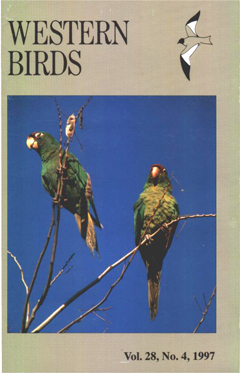
The increasing establishment of parrots in southern California, with populations now exceeding 2,500 individuals in the greater Los Angeles area alone (Garrett 1997), suggests that the impacts of these non-native species on food resources could become substantial.
196-201
KAREN T. MABB
In recent decades, Southern California has seen changes, both increases and decreases, in the population status of many species of birds (Jehl and Johnson 1994).
202-208
KAREN T. MABB
Many species of parrot have established populations well away from their native ranges (Enkerlin-Hoeflich and Hogan 1997; Fisk and Crabtree 1974; Froke 1981; Garrett 1997; Hall 1988; Hardy 1964, 1973; Johnston and Garrett 1994; Morgan 1993; Neidermeyer and Hickey 1977; Shelgren et al. 1975). In Southern California, at least, several species now occur in what appear to be self-sustaining populations (Garrett 1997).
209-217
CHARLES T. COLLINS, LISA M. KARES
Flocks of naturalized parrots and parakeets are a common sight in suburban southern California.
218 -222
JOHN J. WALSH, CARL E. BOCK
The majority of multiple-brooded birds delay several days between the fledging of the first brood and the initiation of a second clutch.
223-224
SEAN P. ROWE, DANIEL S. COOPER
The Nature Conservancy's Kern River Preserve, located along the South Fork Kern River (elevation 2,640 feet) near Weldon, Kern County, California, comprises 1,100 acres of the largest remaining example of cottonwood/willow riparian forest in California.
225-227
Compiled by Jack W. Schlotte and Philip Unitt
228-240