STATUS OWLS IN THE GLASS MOUNTAIN REGION, MONO COUNTY, CALIFORNIA
Knowledge of the distribution and abundance of most species of owls in these areas appears to be based on limited surveys or compilations of anecdotal observations.
1-20

Issue
Published January 1, 1998
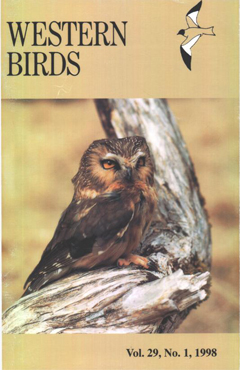
Volume 29, number 1 of Western Birds, published 1998
Knowledge of the distribution and abundance of most species of owls in these areas appears to be based on limited surveys or compilations of anecdotal observations.
1-20
The Queen Charlotte Islands comprise the most isolated archipelago off the Pacific coast of Canada. The islands are separated from the mainland of British Columbia by about 80 km, and from the nearest Alaska islands, Forrester and Dall, by about 70 km and 50 km, respectively.
21-28
Most passerines follow a similar sequence of remex molt, with replacement of the primaries commencing with the innermost and proceeding distally, while that of the secondaries (except for the tertials, S7–S9) begins with the outermost and proceeds proximally.
29-35
The Bufflehead (Bucephala albeola) is a common winter visitor throughout California, occurring mostly along the coast in ocean bays and estuaries. In the interior, it winters in small numbers on lakes and ponds. Small numbers of nonbreeding individuals also summer along the coast, and even fewer still summer on inland lakes and ponds.
36-40
The White-winged Junco (Junco [hyemalis] aikeni) is a United States endemic with a limited range and few acceptable extralimital records. Two of these extralimital records have been in California in recent years, thus adding a taxon to the list of birds recorded in the state.
41-48
On 7 June 1997, we (along with Ted J. Nordhagen) observed an adult Black-tailed Gull (Larus crassirostris) at the fishing village of El Golfo de Santa Clara, near the mouth of the Colorado River in extreme northwestern Sonora, Mexico (31°42' N, 114°30' W).
49-54
"It has long been recognized by those involved in pest control and research that the Black-billed Magpie is one of the most wary and difficult birds to capture alive." — Alsager et al. (1972)
55-58
The well-written introduction includes brief sections on taxonomy, general characteristics (such as plumage polymorphism and kleptoparasitism), breeding behavior, age development and molt, skuas and humans, observing skuas in the field, and an explanation of the species accounts.
60-62
This exciting new photographic guide provides a welcome addition to the growing references available for those bird species grouped under the heading of "seabirds"—in this case, the penguins, Procellariiformes, most Pelecaniformes, the skuas, gulls, most terns, one skimmer, and the auks. Intelligently, non-marine species such as the "white" pelicans are omitted.
59-60
As is often mentioned, a key to good field birding is to become thoroughly familiar with variation in common species. Large gulls, with their inherent plumage variability and propensity to interbreed, provide almost limitless potential for observation and learning.
63-64