STEVEN G. MLODINOW, STEVEN FELDSTEIN, BILL TWEIT
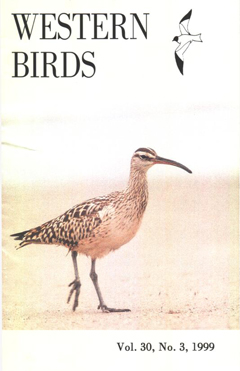
The Bristle-thighed Curlew (Numenius tahitiensis) undertakes one of the longest known transoceanic migrations of any shorebird, commuting between its breeding range in western Alaska and its wintering grounds in the tropical Pacific. Its world population is likely less than 10,000 (Marks 1996), and its breeding population consists of approximately 3,500 pairs (Gill and Redmond 1992).
133-155
MICHAEL A. PATTEN, GUY McCASKIE, JOSEPH MORLAN
On 3 November 1998, Patten, McCaskie, and Daniel S. Cooper discovered an American Woodcock (Scolopax minor)at the Iron Mountain Pumping Plant in southeastern San Bernardino County, California. Patten first noted the bird at about 07:15 PST as it stood in a yard beneath a large planted elm.
The observers subsequently studied the bird through binoculars for 15 minutes at close range (5–10 meters) as it waddled around on a lawn and hid in an adjacent flower bed. It also flew on two occasions. Viewing conditions were excellent (clear skies, 55–60°F, with a stiff Beaufort 3–4 northerly wind).
156-166
BRIAN J. McCAFFERY, MICHAEL L. WEGE, CHRISTOPHER A. NICOLAI
The Spectacled Eider (Somateria fischeri) was described for science from St. Michael, Alaska, over 150 years ago. However, its nonbreeding range remained unknown until recently, when concentrations of molting and wintering eiders in the Bering and Chukchi Seas were finally revealed by satellite telemetry (Petersen et al. 1995, 1999).
167-173
KENNETH C. PARKES
In the Report of the California Bird Records Committee: 1995 Records (K. L. Garrett and D. S. Singer, Western Birds29:133–156, 1998), a sight record of the Common Grackle (Quiscalus quiscula) from Bishop, Inyo County, 29 September 1993, was listed among "Records not accepted: Identification not established.
174
THOMAS P. RYAN, DANIEL A. KLUZA
Little is known about the distribution of the Least Tern (Sterna antillarum) along the Pacific coast of Mexico. It breeds locally (April–August) from northwestern Baja California and the northern Gulf of California south to Chiapas (Howell and Webb 1995; Thompson et al. 1997). From Nayarit southward, it has been reported either as a migrant (Schaldach 1963; Escalante 1988) or as an uncommon permanent resident (Álvarez del Toro 1980; Binford 1989; Villaseñor 1990; Thompson et al. 1997). However, these broad statements are based on relatively few specific observations.
175-176
Michael A. Patten , Steve N. G. Howell
The passing of a generation can often be marked by the appearance of a new Checklist of North American Birds from the American Ornithologists' Union. With each edition, this venerable standard of taxonomy and nomenclature for birds on the North American continent becomes entrenched in the next several decades of publications, ranging from the technical literature to our favorite field guides.
177-180
PETER PYLE
Prior to the 1970s, molt and its effect on age determination in birds—especially in the field—was not a thoroughly studied topic in ornithology. This changed somewhat in 1977, when A. J. Prater, J. H. Marchant, and J. Vuorinen published their influential work, Guide to the Identification and Ageing of Holarctic Waders.
181-184