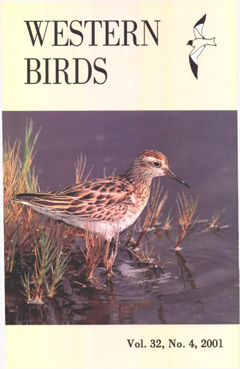
W. DAVID SHUFORD, JOAN M. HUMPHREY, NADAV NUR
We surveyed breeding Black Terns throughout California in 1997 and 1998, following winters of very high runoff. We estimated the state's nesting population at about 4,150 pairs (±30%), of which 47% were in northeastern California and 53% in the Central Valley. The 1,940 pairs in northeastern California were at 60 sites; 59% were at 10 sites and 70% were in Modoc County.
189-217
R. KASTEN DUMROESE, MARK R. MOUSSEAUX, SHIRLEY HORNING STURTS, DANIEL A. STEPHENS, PAUL A. HOLICK
The Black Swift (Cypseloides niger) was first confirmed breeding in Idaho in 1997 and 1998, when four and five pairs, respectively, nested near Shadow and Fern Falls along the North Fork Coeur d'Alene River, Shoshone County. Nest sites were on cliffs composed of argillite within the large Precambrian Belt Supergroup geologic formation and associated with a narrow riparian strip of western redcedar and devil's club. The microcommunity along cliff faces consisted of a variety of mosses, liverworts, and ferns. We analyzed all Black Swift sight records for Idaho, finding that 78% were from the breeding season, and most breeding-season records (96%) were associated with the Precambrian Belt Supergroup.
218-227
OSVEL HINOJOSA-HUERTA, WILLIAM W. SHAW, STEPHEN DeSTEFANO
Populations of California Black Rails (Laterallus jamaicensis coturniculus) have been drastically reduced in western North America over the last several decades (Repking and Ohmart 1977, Evens et al. 1991). The California Black Rail is listed as threatened by the California Department of Fish and Game and is considered a "species of concern" by the U.S. Fish and Wildlife Service (www.dfg.ca.gov/endangered/birds.html). In Mexico, the California Black Rail is listed as endangered (Diario Oficial de la Federación 2000).
228-232
Steve N. G. Howell
The subject matter of BNAW is birds recorded west of the 100th meridian, north of Mexico. A brief introduction explains how to use the book (e.g., the numerous icons), including sections on watching birds and conservation. The introduction is not free of miscues: the “Ruby-throated Hummingbird” photo (p. 13) is of a Plain-capped Starthroat, and in the abundance and distribution terms (pp. 24–25) the European Starling is listed as “abundant,” while the Cattle Egret is “exotic,” and the Antillean Nighthawk (unknown in the West) is “rare.”
233
Peter Pyle
You are on a May pelagic trip off Bodega Bay. You reach the continental shelf, and suddenly the chummed oil slick is joined by one, two, 25, 50, perhaps even 500 incoming bombers: majestic, graceful Black-footed Albatrosses. They splay their feet and eagerly scatter the screeching gulls in search of a morsel of popcorn or suet. Some of them have bleached heads, some are in fresh plumage, some have begun their molt, and others have tattered wings.
234
Steve N. G. Howell
This fine set of recordings appears to be part of a series from Cornell that, to date, has covered Alaska (1999), the Rocky Mountain states and provinces (1999; reviewed in W. Birds 31:64), and the lower Rio Grande Valley and southwestern Texas (2000). The compilation reviewed here contains vocalizations from 151 “Arizona species” (those with “at least one confirmed breeding record in the state”—although, apparently, a nest with two eggs of the Rufous-capped Warbler [Rosenberg and Witzeman 1999. W. Birds 30:94–120] does not qualify, and a further 51 “Sonora species,” including some that stray rarely to southeastern Arizona (e.g., the Plain-capped Starthroat and Yellow Grosbeak).
235-236
KIMBALL L. GARRETT
Minor individual plumage variation in gulls is one of many factors confounding field identification of this notoriously difficult group. Plumage variation can sometimes take the form of more extreme anomalies such as leucism and albinism (Grant 1986). A well-known variant of the Heermann’s Gull (Larus heermanni) shows patches of white on the greater primary-coverts (Hubbs and Bartholomew 1951), as depicted, for example, by Sibley (2000); some individuals have additional white on other wing coverts, scapulars, or remiges (pers. obs.).
237
Mike San Miguel
At our annual meeting in Reno last fall, your WFO board of directors made several important decisions aimed at improving the quality of our journal, increasing our appeal to a broader range of field ornithologists, and ensuring the continued financial health of your organization. Western Birds has and always will be the primary focus of WFO, and we continue to work for its improvement.
238-239