STEVEN G. MLODINOW, PETER PYLE
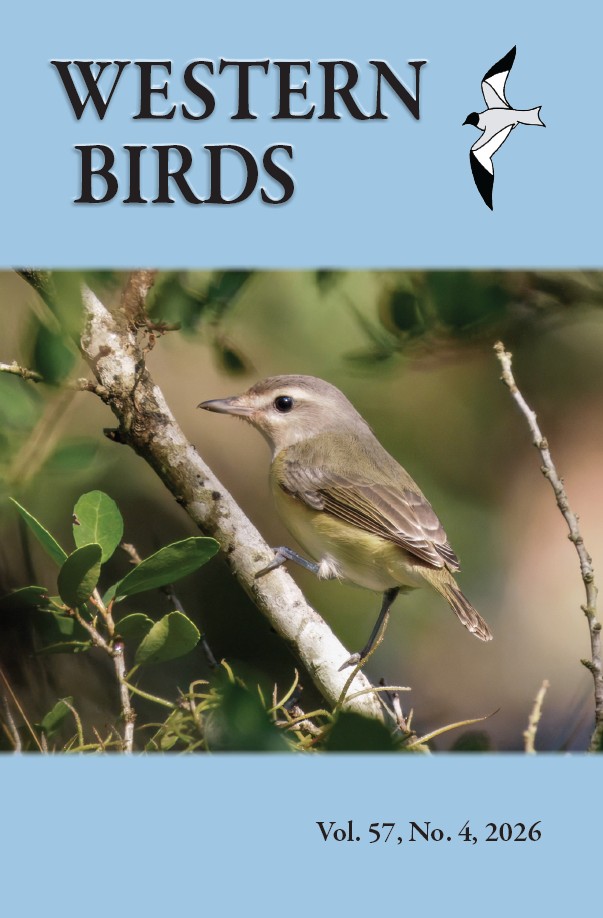
The reclassification of the Eastern (Vireo gilvus) and Western (V. swainsoni) Warbling-Vireos as separate species has stimulated interest in their identification. We examined photographs of 85 Easterns and 89 Westerns in the Cornell Lab of Ornithology’s Macaulay Library, finding the ratio of the distance between the tips of primaries 6 and 5 to that between the tips of p5 and p4, the “p6:5 ratio,” to be the most useful difference. A p6:5 ratio >0.90 eliminates 95% of Westerns and includes 68% of Easterns, whereas a ratio <0.73 eliminates 95% of Easterns and includes 52% of Westerns. Our results support previous reports that the Eastern molts primarily on its summer grounds, before southbound migration, but are counter to reports that all Westerns migrate before molt: 36% of adults and 39% of first-fall birds had molted or commenced molt within the breeding range. Thus retention of worn plumage in adults and juvenile greater coverts in first-year birds suggests a Western, whereas replacement of these feathers does not distinguish the species. Prealternate molt is more extensive in the Eastern than the Western, aiding identification in spring. Applying our findings to records of vagrants, we identified 12 Westerns from east of the Mississippi River and in South America and six Easterns from Alaska, Arizona, California, and the Azores that appear to represent vagrants. Distinguishing many, but not all, Eastern and Western Warbling-Vireos is possible with high-quality images in which the spacing of primaries, facial markings, molt state, and/or side coloration can be assessed.
250–276
RAYMOND J. DAVIS, NATALIE M. RUGG, MICHAEL H. HUHNDORF, JOSEPH M. CHOW
In the Pacific Northwest region of the United States, forests within the range of the Northern Spotted Owl (Strix occidentalis caurina) have changed dramatically over the last two centuries. It began with the loss of frequent fires that indigenous communities set annually to manage their natural resources. This change was exacerbated a century later with the advent of effective fire suppression by the United States Forest Service. A once diverse forested landscape maintained by frequent fires became more uniform. In recent times, urbanization and widespread timber harvesting largely confined remaining owl habitat to federally managed public forest lands. In some places there was less than historically existed and in other places, more. These changes can create ecological traps—areas of low-quality habitat that are occupied for various reasons—where long-term persistence is not possible. A recent (2024) article in Western Birds focused on a Northern Spotted Owl territory that produced three young two years after a large, severe wildfire. Our paper broadens the time perspective for that territory and tells a more holistic story of how the owls occupied it prior to and after the fire. The rapid change in this territory, now unoccupied, is an example of a site-level ecological trap for the Northern Spotted Owl, while the slow forest changes from fire exclusion that preceded the fire exemplify a landscape-scale trap.
277–294
TRIANA I. HOHN, LUKAS MILLER, ELIZABETH A. GOW
Most bird species evolved nest characteristics such as height or type of materials that match their life history and niche requirements. Many species, including the Spotted Towhee (Pipilo maculatus), commonly nest on the ground or in low shrubs. Urban environments, which comprise many novel anthropogenic structures and related pressures, can alter bird behaviors, including nest-site selection. As part of a multi-year field study in Metro Vancouver, British Columbia, Canada, we located a Spotted Towhee nest that was 7.0 m high. This nest was 2 m higher than the highest nest previously documented in the literature and was much higher than the mean nest height of 0.2 m (median = 0 m) that we have observed in this region. This discovery suggests that the Spotted Towhee’s nest-site selection may be more plastic than previously documented and highlights a need to consider factors, particularly in human-modified environments, that influence nest-site selection.
295–302
MAX HELLICAR
Molt is a crucial component of the avian annual cycle, and precise knowledge of its extent, sequence, timing, and duration is key to understanding a species’ life history. Differences in molt patterns allow individuals of most temperate-zone songbird species to be categorized as first-cycle or older. The extent of molt, however, can vary among individuals of a species, and knowledge of the frequency of unusually extensive or limited molts is critical for accurate age determination. During banding of 100 first-year Spotted Towhees (Pipilo maculatus) on Vancouver Island in autumn 2025, I noted two individuals in which the preformative molt was exceptionally extensive. In these individuals, up to six primaries, five secondaries, and seven primary coverts had been renewed. The patterns of these feathers’ replacement had evidently followed eccentric and typical sequences concurrently, a combination previously documented in only seven North American passerine species. These results improve our understanding of molt in the Spotted Towhee and suggest that extensive replacement of juvenile flight feathers could improve the birds’ fitness by furnishing higher-quality feathers that may enhance flight performance, thermoregulation, and resistance to wear, potentially providing an adaptive advantage in abrasive environments.
303–310
ALLISON ANHOLT, JOSEPH B. BUCHANAN, CAMERON D. COX, VANESSA LOVERTI, LIAM HUTCHESON, JASON P. LOGHRY, ROBERTA SWIFT
We document the first two records of the Great Knot (Calidris tenuirostris) for Washington, which also represent the second and third records of the species during spring migration in the Pacific Americas Flyway south of Alaska. The first Great Knot, which was in breeding plumage, was observed 15–20 May 2024, the second, in basic plumage, 12–18 May 2026. Both were at Willapa Bay: the one in 2024 was seen initially south of the mouth of North River Cove and subsequently at Ellen Sands, a high-tide roost site. The one in 2026 was observed at Ellen Sands on four dates. It is likely that the two Great Knots overwintered in northwestern Mexico and migrated northward with Red Knots (C. canutus).
311–316
ROBERT A. HAMILTON
Birds of California’s Channel Islands, by Paul William Collins, Justyn Todd Stahl, and Harry Lee Jones. Santa Barbara Museum of Natural History Monographs No. 9, Studies in Biodiversity No. 7. Two volumes, 781 pages. Hardcover, $129.00. ISBN-13: 978-0-936-49420-3. Volume 1, Ecology, History, and Human Influence.
317–322
Daniel D. Gibson, Angela Tidmore
Compiled by Daniel D. Gibson and Angela Tidmore
323–330